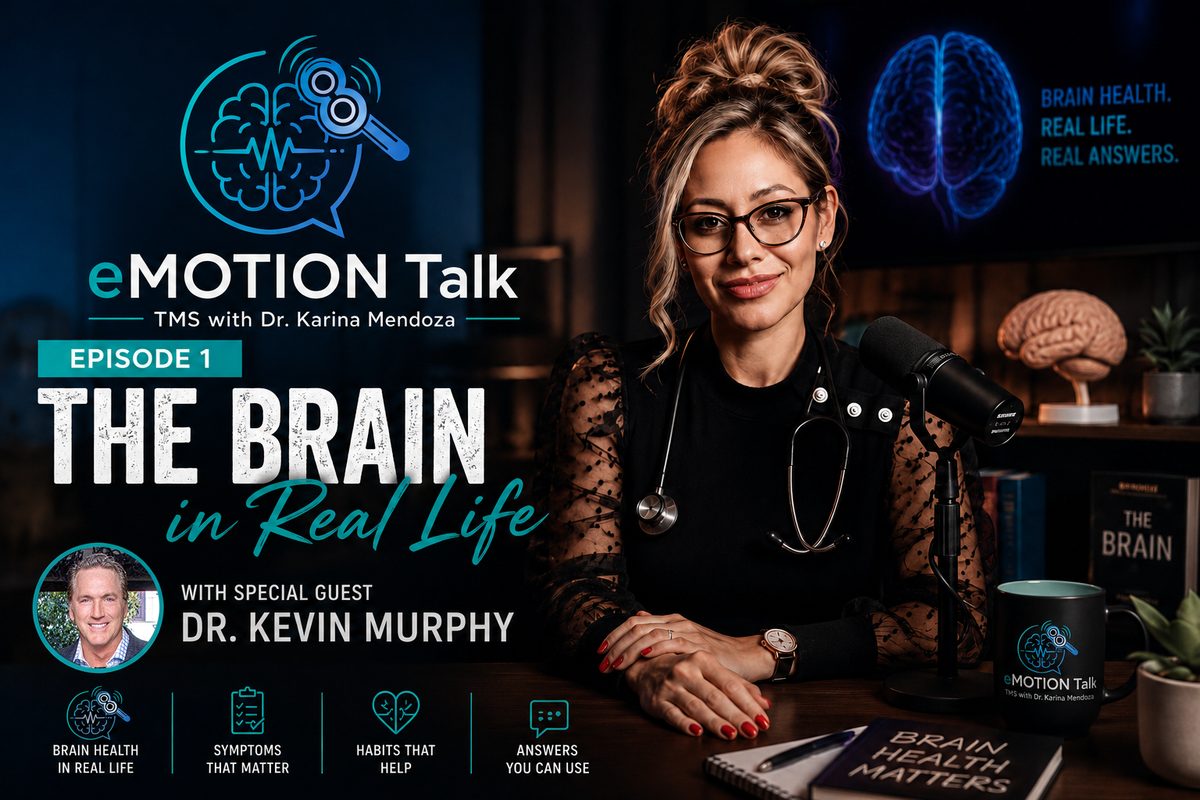
Episode 1
The Brain in Real Life
Guest: Dr. Kevin Murphy — Neuroscience & clinical research · 48 min
Video coming soon
Summary
In this episode of eMOTION Talk, Dr. Karina Mendoza sits down with Dr. Kevin Murphy to discuss how brain health actually shows up in everyday life. The conversation focuses on the patterns behind mood, focus, and energy, why context matters when reading symptoms, and how small daily inputs add up. This episode is educational and designed to help viewers ask better questions, notice patterns, and understand brain health in real life.
Key takeaways
- Brain health shows up in daily function, not only in clinical language.
- Symptoms should be understood in context, not in isolation.
- Sleep, stress, hydration, movement, and food stability can affect how people feel and function.
- TMS questions should be discussed with a qualified provider.
TMSbrain healthdaily function

Special guest
Dr. Kevin Murphy
Neuroscience & clinical research
Related resource
The Daily Brain Audit Checklist
A 7-day practical tracker for sleep, hydration, food stability, movement, stress, screen load, symptoms, and function.
Educational only. This episode is for educational purposes only and does not provide medical advice, diagnosis, or treatment. It does not replace individualized medical evaluation.